
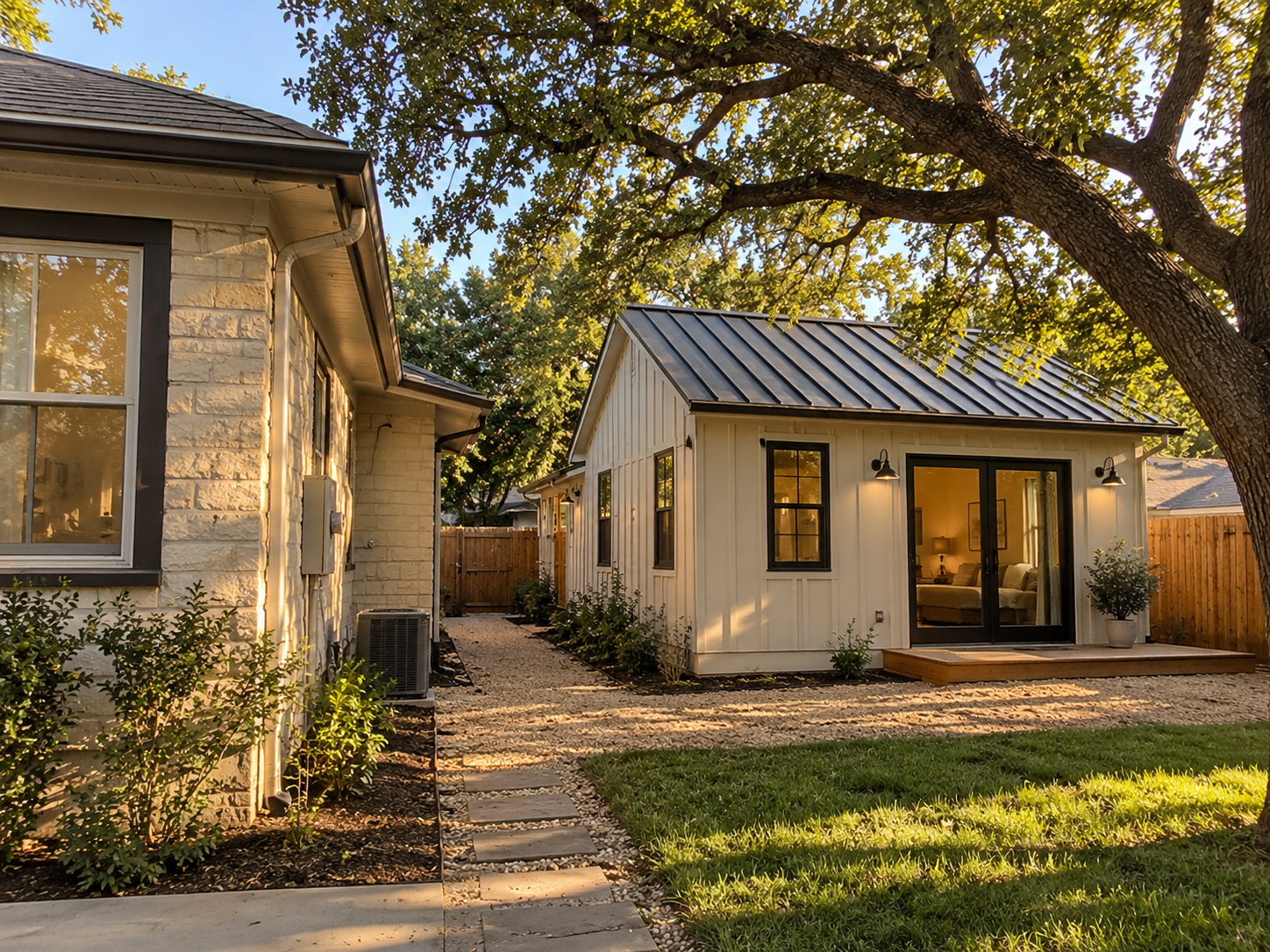
Austin Property Guide
The highest-rent neighborhood does not automatically produce the best second dwelling.
Austin ADU Guide 2026 Rules, costs, rental income and return
An additional dwelling unit can be a good investment, a way to house family, or an expensive structure that never earns back what it cost. Which one you get depends on three things: whether the property can legally and physically support a second dwelling, what it will cost to build, and what the finished unit can realistically earn. This guide covers all three for properties inside the City of Austin.
One caution first. Austin's development rules apply inside the City's jurisdiction, not to every address with an Austin mailing address. Before assuming anything here applies, confirm where the property sits on the City's jurisdiction map and its zoning on Property Profile.
Section 01
What Qualifies as an ADU in Austin?
First, the vocabulary. Austin's code and permitting pages say Additional Dwelling Unit. Most of the country, most lenders and most appraisers say accessory dwelling unit. Both shorten to ADU and describe the same thing: a second, self-contained home on a lot that already has one. This guide uses ADU throughout and flags where the City's definition and a lender's diverge.
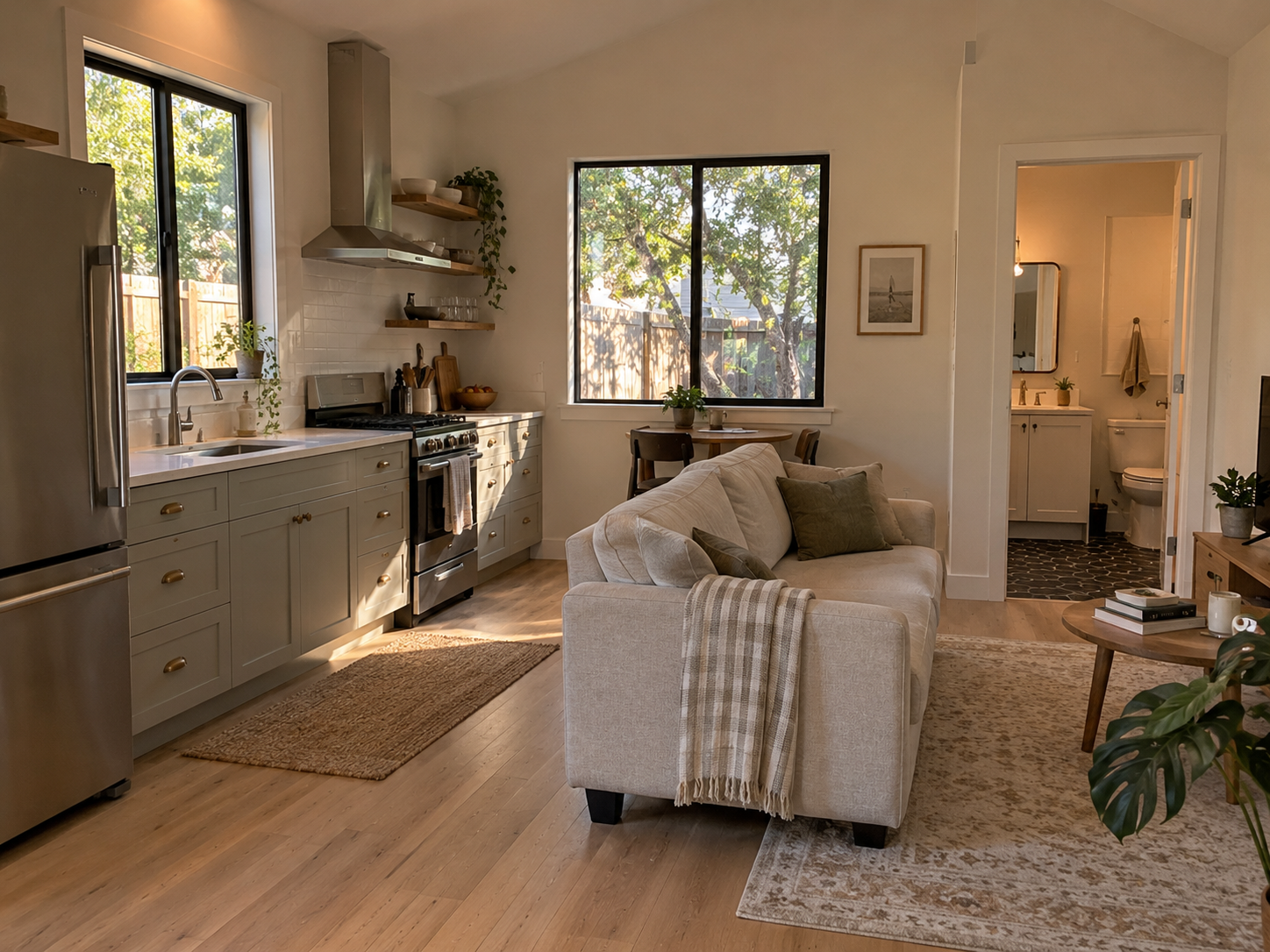
The City is specific about what counts. A structure, or part of one, is a dwelling unit if it contains habitable space, a full bathroom and permanent cooking facilities. Anything meeting all three must follow the rules that apply to a dwelling unit, including zoning, utility meter, internal access, occupancy and address requirements.
| Term you see in a listing | What it actually establishes |
|---|---|
| ADU or additional dwelling unit | A separate dwelling, not extra finished square footage. Verify permits and the certificate of occupancy, not the description. |
| Studio apartment | An open-plan layout can still be a dwelling unit. A separate bedroom is not the test. |
| Art studio or backyard office | Work or hobby space. Power and insulation do not make it approved residential accommodation. |
| Casita, guesthouse or guest suite | Nothing about permitted use or rental eligibility. HOME Phase 1 eliminated guest houses and accessory apartments as categories of accessory use. |
| Garage conversion | A construction approach. The completed facilities and the approvals determine what it legally is. |
Based on the City of Austin's Additional Dwelling Units page and the HOME Amendments page, reviewed October 2026.
A second definition matters just as much, and buyers rarely hear it until underwriting: your lender applies its own ADU criteria, on its own timetable. Those rules changed in 2026. See Section 07.
Section 02
Can You Build Another Dwelling on This Property?
HOME Phase 1, adopted in December 2023, allows up to three housing units on SF-1, SF-2 and SF-3 property and eliminated the old primary versus accessory use distinction. HOME Phase 2 is a different thing: it created a small lot single-family use permitting one unit on lots of at least 1,800 but under 5,750 square feet. It is not permission to put three dwellings on an 1,800 square foot lot.
For that path the City lists a 5,750 square foot minimum lot area, zoning in SF-1, SF-2 or SF-3, a unique address for each new unit obtained before the permit application, fire separation compliance, and unit size limits that vary by district and location. Zoning no longer requires minimum distance between units, though the International Residential Code still governs separation.
The Property-Level Checks That Actually Decide It
Meeting the zoning and lot-size thresholds gets you to the starting line. The specific site determines whether a project is feasible and what it costs.
- Jurisdiction. Full purpose, limited purpose or ETJ. Different rules apply.
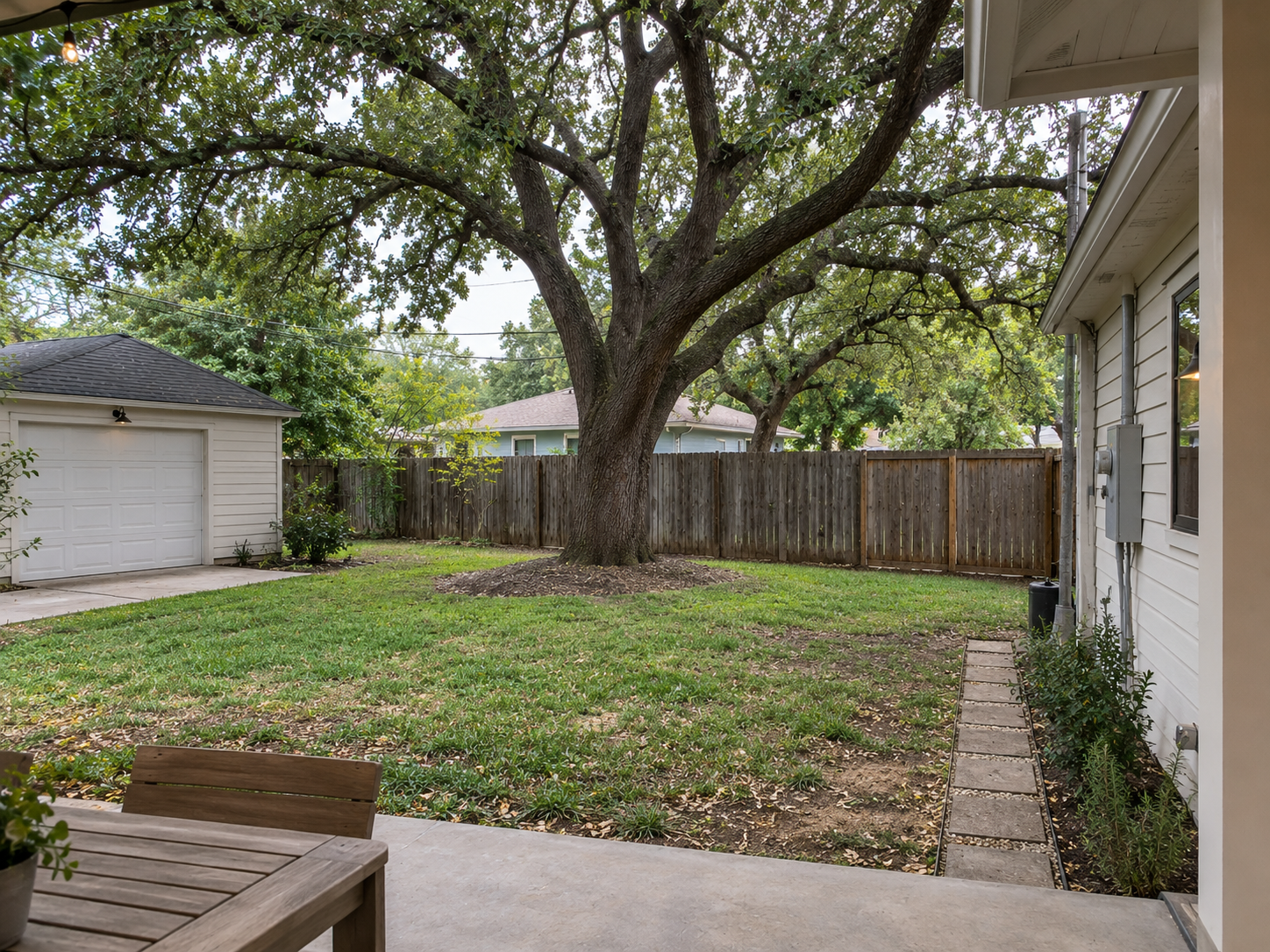
- Existing buildings, setbacks and floor area. Under HOME, maximum building coverage for two- and three-unit uses is 40% and impervious cover 45%. Garages and carports count toward both.
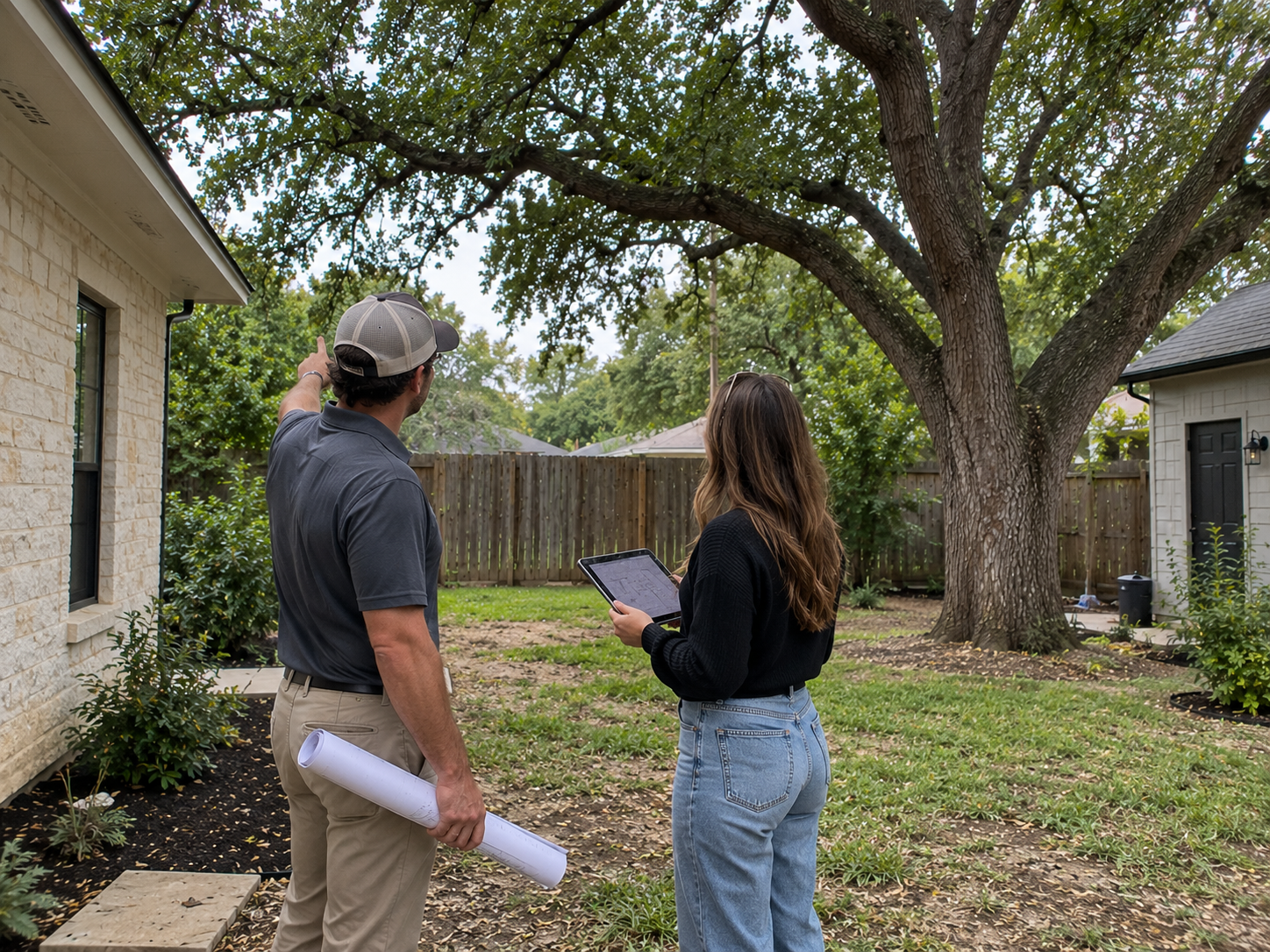
- Trees. Regulated trees and their critical root zones can determine where a structure can go, or whether it can go anywhere.
- Floodplain and drainage. Both can restrict proposed buildings and the work around them.
- Utilities and easements. Where service comes from, what it costs to extend, and what sits in the way.
- Deed restrictions and restrictive covenants. The City reviews only City requirements, even where a proposal conflicts with private restrictions. Checking those is the applicant's responsibility, and they can prohibit what the City would permit.
Worth Knowing
As of the City's October 6, 2026 update, 931 HOME Phase 1 applications had been reviewed, 742 approved and 1,482 new units approved. Read those carefully. HOME Phase 1 covers duplex, two-unit and three-unit residential projects, so the count is not a count of ADUs. And approvals are not completed, occupied units. Permit tallies are routinely cited as evidence of how many ADUs exist, and they do not measure that.
Section 03
What Will You Actually Use It For?
Not every ADU owner is an investor, and the four common uses have different economics. Decide which you are planning before pricing anything.
Long-term rental
The base case, and the one to underwrite first because it rests on the fewest assumptions. Weigh achievable rent against vacancy, operating expenses and financing.
Furnished monthly rental
Account for utilities, furniture replacement and turnover, and verify demand with actual 30-day-plus lease comparables. A furnished premium is not automatically higher net income.
Family or multigenerational housing
Privacy, accessibility and flexibility matter more than yield. The comparison is what alternative housing would cost, not what the unit could rent for. Worth building even when the paper return is unremarkable.
Personal studio or office
Compare the workspace you want against the added scope a dwelling requires. Without a kitchen and full bath you may not need a dwelling unit at all.
Short-Term Rental Is Its Own Model
Austin defines a short-term rental as a residence rented for less than 30 consecutive days. The Council rebuilt the framework in 2025.
Ordinance 20250227-039 added Section 25-2-904, making short-term rental an accessory use to residential use in every zoning district, stating the use cannot be prohibited, and requiring an operating license under Chapter 4-23. It also deleted Section 25-2-1463(C)(6), which had barred a secondary apartment from short-term rental use for more than 30 days a year. Those changes took effect October 1, 2025, alongside Ordinance 20250227-040, which created the licensing program. Licenses now run two years, and platform regulations took effect July 1, 2026.
One City Webpage Has Not Caught Up
As of our October 2026 review, the City's ADU page still states that an ADU built after October 1, 2015 may not be short-term rented more than 30 days a year. That tracked the provision the Council deleted, so the page appears out of date rather than describing a surviving rule.
The same page says a certificate of occupancy must accompany a license application, while the program page says it is no longer required. Separate those. The licensing paperwork changed. The building approval did not. A certificate of occupancy is still what final inspection produces and still the document showing a unit was legally completed. Ask for it regardless, and confirm the rest with Austin Development Services.
Either way, make a long-term rental the base case and treat any short-term scenario as upside you verify separately. A project that only works at nightly rates depends on the next rewrite going your way.
Section 04
What Does an Austin ADU Really Cost?
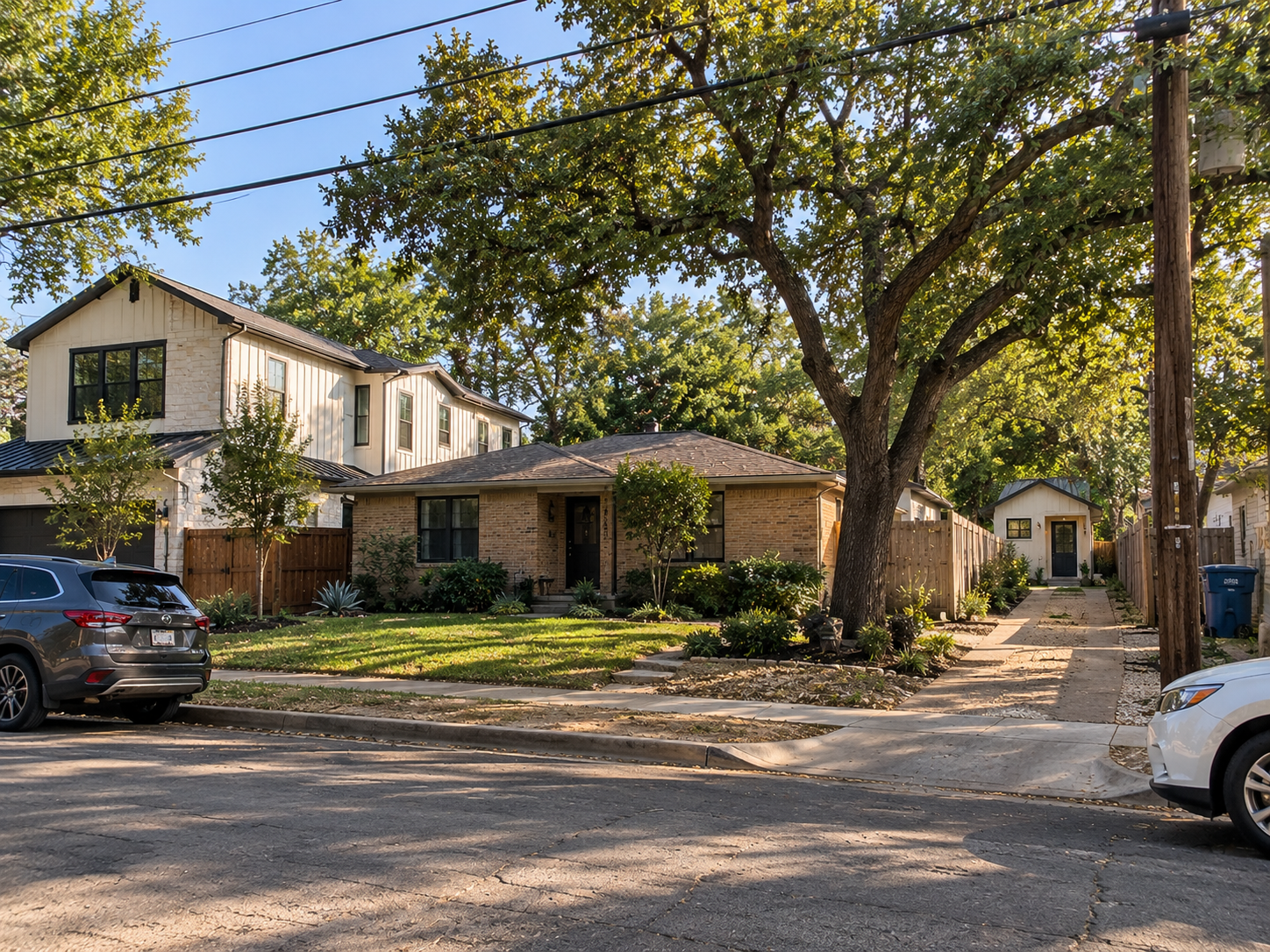
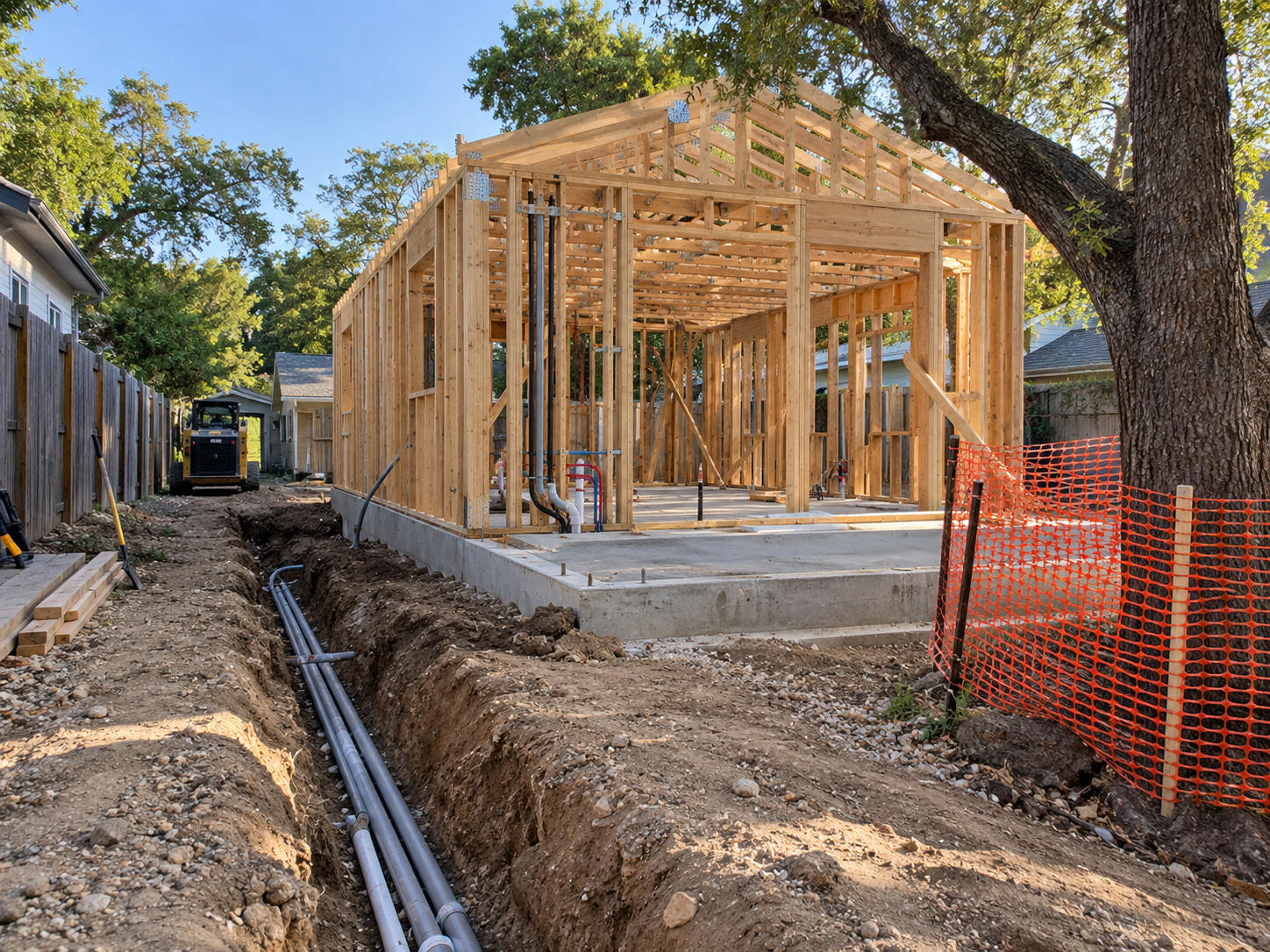
We are not going to publish a cost per square foot. Pricing moves, and the gap between an easy site and a difficult one is wide enough that any single figure would mislead. What a complete estimate must include is more useful, because it lets you tell a real number from a partial one.
Two traps are worth naming. A prefabricated unit's advertised price is a unit price, not an installed project cost, unless the quote covers site work, foundation, utilities, permitting and restoration. And utility costs depend on what the property already has, so price the actual service requirement.
| Category | What belongs in it |
|---|---|
| Design and engineering | Architectural plans, structural engineering, energy compliance, revisions during review. |
| Survey and permitting | Current survey, tree survey where applicable, plan review fees, permit fees, address assignment. |
| Site preparation | Access for equipment, demolition, grading, tree protection, retaining, drainage work. |
| Foundation and structure | The slab or piers and the building itself, including fire separation requirements. |
| Utilities | Water and wastewater service, electrical service, metering, gas if applicable, and any connection or impact fees that apply to the specific service requirement. |
| Finishes and fixtures | Kitchen, bath, flooring, HVAC, appliances. |
| Site restoration | Landscaping, fencing, paving and hardscape repair after construction. |
| Contingency | A real allowance, not a rounding number. Older sites produce more surprises. |
| Carrying costs | Interest, insurance and taxes during the build, plus the lease-up period before the first rent arrives. |
Austin Water's published fees distinguish different connection and impact fee circumstances, which is why that line cannot be carried as a guess.
Get two or three itemized estimates for the same design and site conditions. If one is dramatically lower, find the line items it left out.
Section 05
Where in Austin Could an ADU Attract Stronger Rental Demand?
Start with the question a renter actually answers. An ADU has to be chosen over a nearby apartment, duplex or small house at the same total monthly cost. What decides that is rarely the neighborhood name. It is independent access, privacy, outdoor space, in-unit laundry, parking where the tenant needs it, and a commute to where they personally go.
The market context first. In September 2026 the City of Austin saw 1,170 closed leases at a median rent of $2,195, down 4.4% year over year, with active lease listings down 31.7%. For the broader Austin-Round Rock-San Marcos MSA the median was $2,100 across 2,242 closed leases.
Source: Unlock MLS, September 2026 Central Texas Housing Report, October 13, 2026. These cover MLS-tracked leases of all types, not ADUs, and a small secondary unit will not necessarily lease at the median.
That cuts against the usual ADU pitch. Median rent declined while lease inventory tightened. Neither figure tells you what a small backyard unit earns on a specific street, but together they mean a projection built on rising rents needs support beyond optimism.
Six Areas Worth Screening First
These are screening priorities, not rankings. None is backed here by ADU-specific rent or return data, because that evidence comes from closed leases on comparable units. Each pairs a documented access advantage with what to price against and what to verify on the parcel.
Crestview, Brentwood and Highland
Access: Crestview Station at 6920 North Lamar and Highland Station at 6420 Airport Boulevard, both on CapMetro's Red Line.
Price it against: closed leases, not asking rents, for one-bedroom apartments and small houses within walking distance of the same platform.
Verify on the lot: the actual walking route and distance to the platform, whether the rear yard still holds a unit plus any parking you intend after the 45% impervious cover limit, and the capacity of existing water, wastewater and electrical service.
Hyde Park, North Loop and Hancock
Access: walking and short-bus distance to the UT main campus and the hospital cluster around 32nd to 38th Streets.
Price it against: closed leases on studios and one-bedrooms nearby, separating units priced per bed from units priced whole, because the two are not comparable.
Verify on the lot: whether a historic district or neighborhood conservation overlay applies to the specific parcel, which can constrain design or add cost. Check Property Profile rather than inferring from the block.
Cherrywood, Windsor Park and Mueller-adjacent
Access: the Mueller district and its medical and retail employment, plus MLK Station at 1717 Alexander Avenue.
Price it against: closed leases both in the Mueller apartments and in the surrounding older stock, since those two bracket what a renter will actually weigh.
Verify on the lot: the rear yard dimension that survives setbacks, whether the unit can be given its own approach from the street or alley, and remaining building coverage.
Holly, East Cesar Chavez and parts of Govalle
Access: Plaza Saltillo Station at 1501 East 5th Street, one stop from Downtown Station, plus walk and bike access to downtown employment.
Price it against: closed leases on secondary units specifically, confirming parcel by parcel that each comparable is a secondary unit and not a separately owned rear home.
Verify on the lot: floodplain and creek conditions, lot width against the equipment access a build requires, and the recorded plat, since configuration varies block to block.
Bouldin Creek, Travis Heights, Zilker and parts of Dawson
Access: South Congress and South Lamar, Zilker Park and Barton Springs, and short trips to downtown.
Price it against: closed leases on small whole houses and condos nearby, which are the direct substitute a renter considers here.
Verify on the lot: slope and drainage, heritage trees and their critical root zones, watershed regulations where they apply, and what the land itself cost, because acquisition is part of the return even when the house is already yours.
Selected North Austin properties
Access: The Domain, served by Kramer and McKalla Stations, and UT's J.J. Pickle Research Campus, 475 acres immediately south of the Domain housing the Texas Advanced Computing Center and Applied Research Laboratories.
Price it against: closed leases at nearby apartment communities, including any concessions offered, since a concession lowers the effective rent a renter compares you to.
Verify on the lot: the recorded deed restrictions and any HOA covenants for the subdivision. Pull the documents from the county records. They can prohibit what the City would permit.
Stronger Demand Is Not the Same as a Better Return
Nothing above says a central property beats a suburban one. A property farther out can outperform a central one on a short commute to where the tenant actually works, the features that make an independent unit worth choosing, and price. The reverse holds too: a premium address with a difficult lot can return less than a plain one that built cheaply and leases steadily.
Keep the two questions separate. Demand affects how fast a unit leases and at what rent. Return depends on achieved rents rather than asking rents, concessions, actual lease-up time, real operating expenses and full project cost. An area can support good demand and still be the wrong place to build.
Section 06
How to Calculate the Return
Gross annual rent divided by construction cost is not an ROI analysis. Decide which question you are answering.
| Measure | The question it answers |
|---|---|
| Rental operating income | What remains after vacancy and operating expenses, before debt service? |
| Cash flow after financing | What remains after loan payments and the reserves in your model? |
| Resale value contribution | What does the market appear willing to pay for the additional dwelling? |
| Overall investment return | How do income, financing, total capital, holding period and eventual sale proceeds work together? |
A Worked Comparison
Every number below is an invented assumption chosen to illustrate the method. None is an Austin quote, a neighborhood estimate or a recommended budget. Assume an existing homeowner comparing two all-cash projects.
| Illustrative input | Project A | Project B |
|---|---|---|
| Total incremental project cost | $240,000 | $330,000 |
| Monthly rent | $2,000 | $2,400 |
| Annual scheduled rent | $24,000 | $28,800 |
| Vacancy allowance | 5% | 5% |
| Rent after vacancy allowance | $22,800 | $27,360 |
| Annual operating expenses | $7,800 | $9,000 |
| Annual replacement reserve | $1,200 | $1,200 |
| Annual cash flow before debt and income taxes | $13,800 | $17,160 |
| Cash flow divided by incremental project cost | 5.75% | 5.20% |
Be clear on what those expense lines contain. Annual operating expenses covers incremental insurance and property tax on the second dwelling, utilities not billed to the tenant, routine repairs and turnover, landscaping and pest control, and management if you use it. The replacement reserve funds components that fail on a schedule: roof, HVAC, water heater and appliances. Neither includes debt service or income taxes, which is why the result is cash flow before debt and income taxes rather than net income.
Project B produces more dollars. Project A produces more cash flow per dollar invested. Which is better depends on whether you are optimizing for total income or efficiency of capital, which is a question about your situation rather than about ADUs.
That final percentage is not a whole-property cap rate and not a total investment return. It excludes acquisition cost and land value, financing, resale proceeds and any change in the main home's value. If you are buying a property specifically to add a second dwelling, evaluate the entire acquisition and development investment. An existing homeowner's incremental return does not transfer to that buyer.
Looking at a property with ADU potential?
We can compare nearby sales and rentals, identify the questions this specific property raises, and coordinate next steps with qualified design, lending and legal professionals.
Schedule a Consultation
Section 07
Will It Increase Resale Value or Help With Financing?
Resale Value Is a Separate Investigation
A $250,000 ADU does not automatically add $250,000 of value. Fannie Mae requires the appraiser to analyze the unit's effect on value and marketability, and generally treats its area separately from the primary dwelling's finished area. Multiplying ADU square footage by a neighborhood price per square foot is not a defensible substitute.
In comparable sales, a main home and ADU sold together is not the same product as a separately owned rear condominium unit. A separate-sale strategy needs its own legal and development work, and the City treats subdivision as distinct from zoning and building approval.
The Lender's ADU Rules Changed in 2026
Two standards are in circulation right now. Under the long-standing Selling Guide, Fannie Mae permits one ADU on a primary one-unit dwelling and none with a two- to four-unit dwelling, which is still what applies on a legacy appraisal. The UAD 3.6 Policy Supplement expands that. For loans sold on or after March 31, 2026 where the appraisal uses UAD 3.6, the allowances for a non-manufactured home are:
| Property | ADUs permitted |
|---|---|
| One-unit principal residence | Up to three |
| Two-unit principal residence | Up to two |
| Three-unit principal residence | One |
| Four-unit dwelling | None |
| Second home or investment property | None |
Source: Fannie Mae UAD 3.6 Policy Supplement, SB2-3-04, reviewed October 2026. Manufactured homes follow a separate schedule. Mixed-use properties are not eligible. These allowances replace the legacy limits only on loans using UAD 3.6.
Two conditions carry the weight. The expanded allowances apply to principal residences only, so a property bought purely as a rental does not get them, and they apply only on a UAD 3.6 appraisal.
The UAD 3.6 deadline is November 2, 2026, but it is not absolute. The GSEs created a one-time exception: approved sellers unable to implement in time may request permission to keep submitting legacy UAD 2.6 appraisals through May 19, 2027. A lender on that exception is still underwriting to the legacy one-ADU limit well into 2027, so ask which standard applies to your loan.
Two Separate Permissions
Lender eligibility and City approval are different questions, and neither substitutes for the other. Fannie Mae allowing three ADUs authorizes nothing in Austin. Austin permitting three units does not make the loan available. A project needs both, decided by different parties on different timelines.
The physical requirements are the same under either standard. An ADU is living area independent of the primary dwelling, on the same parcel, subordinate in size, with its own ingress and egress, kitchen, sleeping area and bathroom. It is not an ADU if it can only be reached through the primary dwelling, or if the space is open to it with no expectation of privacy. The kitchen needs cabinets, a countertop, a sink with running water and a stove or stove hookup.
Whether a lender reads a HOME three-unit project as a house with ADUs or as a multi-unit property depends on separate utility meters, a unique postal address and whether the unit can legally be rented. The appraiser makes that call, and the same three structures can be a very different loan depending on it.
Financing the Project Itself
Buying a home with an existing permitted unit is a different financing problem from building one. Renovation and construction-to-permanent products exist for the latter, but eligibility depends on the project and borrower, and not every lender offers them. Start that conversation early, and do not assume projected ADU rent will help you qualify.
Section 08
What to Check Before Buying or Building
If the property already has a second unit
- Permit history and the certificate of occupancy for the unit, not the listing description
- Whether the configuration meets the City's dwelling unit definition and your lender's ADU criteria
- Separate address, metering and access arrangements
- Current lease terms, if occupied, and whether they transfer
- How the appraiser is likely to treat it, which your lender can preview
- Any STR license history and what the current rules permit for this specific unit
If you plan to build one
- Every property-level check in Section 02, starting with jurisdiction and zoning confirmed on the City's maps rather than assumed from the address
- Two or three itemized construction estimates for the same scope
- A realistic timeline, including review, permitting, construction and lease-up
- What the finished unit would add to property taxes and insurance
- Closed lease comparables for genuinely comparable independent units, not asking rents
A real estate agent cannot give legal, engineering or lending advice, and this guide does not replace a design professional, a lender or an attorney. What an agent can do is help you screen properties before you pay for a feasibility study, and say when a property's constraints make the project unlikely to pencil.
Section 09
Questions We Get About Austin ADUs
Is a casita an ADU?
Sometimes. The word establishes nothing. Austin treats a structure as a dwelling unit when it has habitable space, a full bathroom and permanent cooking facilities, and HOME Phase 1 removed guest houses and accessory apartments as categories of accessory use. Check the permits and the certificate of occupancy.
Can I convert my garage into an ADU?
Possibly, if the property qualifies and the finished space meets dwelling unit requirements, including fire separation and a unique address. A garage conversion describes the construction approach, not the legal outcome.
Can I rent the ADU out separately?
For a long-term lease, generally yes once the unit is permitted and has its own address, subject to any deed restrictions. Short-term rental is separate, with its own licensing under Chapter 4-23. Ordinance 20250227-039 deleted the old 30-day limit on secondary apartments, though a City webpage still cites it. Confirm with Austin Development Services.
Can I sell the ADU separately from the main house?
Not without additional legal and development work. Selling a rear unit separately generally requires subdivision or a condominium regime, and the City treats subdivision as distinct from zoning and building approval. Talk to an attorney first.
Does an ADU increase property taxes?
Adding improvements generally affects appraised value, which affects the tax bill. The amount depends on the appraisal district's assessment, so ask them or a tax professional rather than estimating from construction cost.
How do I estimate the return?
Start with achievable long-term rent supported by closed lease comparables, subtract vacancy, operating expenses and a replacement reserve, and compare the result to the full project cost including design, permitting, utilities, site work and contingency. Then decide separately whether you are measuring cash flow, resale contribution or total investment return.
Considering a Home With ADU Potential?
Shipman Partners can compare nearby sales and rentals, identify the questions a specific property raises, and coordinate next steps with qualified design, lending and legal professionals. If the property or the numbers do not support the project, we would rather tell you before you spend money finding out.
Let's look at the property together
We can pull nearby sales and closed lease comparables, flag the zoning, site and title questions a specific lot raises, and point you to the right design, lending and legal professionals before you pay for a feasibility study.