
Austin Market Strategy
Slower does not mean inactive. It means fewer chances to recover from a weak start.
Buying or Selling a Home in Austin This Winter A 2026-2027 strategy guide
From November through February, the Austin-area market carries fewer buyers, fewer new listings and less tolerance for a mispriced launch. Sellers have a smaller pool to reach and less room to recover from a weak first two weeks. Buyers may find room to negotiate, but that room is specific to individual listings rather than general to the season, and it often shows up in terms rather than price.
At Shipman Partners, we work with Austin-area buyers and sellers through these quieter months, where pricing, market time and negotiation strategy can matter differently than they do during the spring rush. What follows is built on the most recent completed Austin winter and the latest published market report.
Section 01
Is Winter Actually Slower in Austin?
Yes, but the shape of the slowdown is more useful than the fact of it. Read closed sales and pending sales as two different stories, because they are.
| Month | Closed sales | Pending sales | Active listings | Months of inventory | Avg close to list |
|---|---|---|---|---|---|
| November 2025 | 655 | 753 | 4,064 | 4.9 | 91.8% |
| December 2025 | 844 | 594 | 3,359 | 4.0 | 90.9% |
| January 2026 | 509 | 797 | 3,262 | 3.9 | 90.8% |
| February 2026 | 664 | 923 | 3,148 | 6.2 | 92.1% |
Source: Unlock MLS Central Texas Housing Reports for November 2025, December 2025, January 2026 and February 2026. City of Austin figures only. Months of inventory and average close-to-list price are as reported by Unlock MLS. This is one completed cycle and does not predict how the next one will behave.
Why Closed Sales and Pending Sales Disagree
A closed sale records a transaction that funded; a pending sale records a property that went under contract. Because a financed purchase takes weeks from contract to closing, closed sales describe decisions made a month or more earlier, while pending sales describe decisions buyers are making now.
December 2025 posted the highest closed sales of the four months at 844 and the lowest pending sales at 594, then January closed sales fell to 509, the low point of the cycle. This pattern is consistent with the normal contract-to-close lag: December closings came from fall contracts, and the December contract count showed up in the January closings. Consistent with that timing is not proof of it, and other factors can move either series.
Then it reversed. Pending sales rose to 797 in January, up 9.3% year over year, and to 923 in February, up 15.1%. Average close-to-list bottomed at 90.8% in January and recovered to 92.1% in February. Active listings declined all four months.
The Practical Takeaway
Treating November through February as one continuous condition is a mistake. A seller watching only closed-sale headlines in January would have seen the worst month of the winter while contract counts were rising.
Section 02
What Is Different Going Into Winter 2026-2027
This article was prepared in early November 2026. The figures below are the most recent published numbers, not forecasts. No one can yet tell you what November 2026 through February 2027 will look like.
| Measure | City of Austin | Austin-Round Rock-San Marcos MSA |
|---|---|---|
| Closed sales | 777 (-12.7% YoY) | 2,223 (-14.8% YoY) |
| Median sale price | $570,958 (+4.2% YoY) | $421,000 (+1.4% YoY) |
| Active listings | 4,502 (-10.3% YoY) | 13,465 (-3.4% YoY) |
| Pending sales | 743 (-8.6% YoY) | 2,313 (-1.8% YoY) |
| Months of inventory | 5.4 | 5.4 |
| Avg close-to-list price | 92.5% (vs 90.8% a year earlier) | 92.7% (vs 91.4% a year earlier) |
Source: Unlock MLS September 2026 Central Texas Housing Report, released October 13, 2026, the newest month published as of November 4, 2026. Months of inventory and average close-to-list price are as reported by Unlock MLS.
Three things there matter. Active listings are down, not up: inventory fell 10.3% year over year, so buyers are not walking into a glut of choices. Closings fell further than inventory, so both sides have thinned, with months of inventory at 5.4, equal to about five and a half months of the recent closing pace. Close-to-list improved to 92.5%, meaning closed prices were nearer to asking prices in aggregate. That alone does not establish whether buyers became more aggressive, sellers priced more accurately, or the mix of homes that sold changed.
Mortgage Rates Are the Variable Nobody Controls
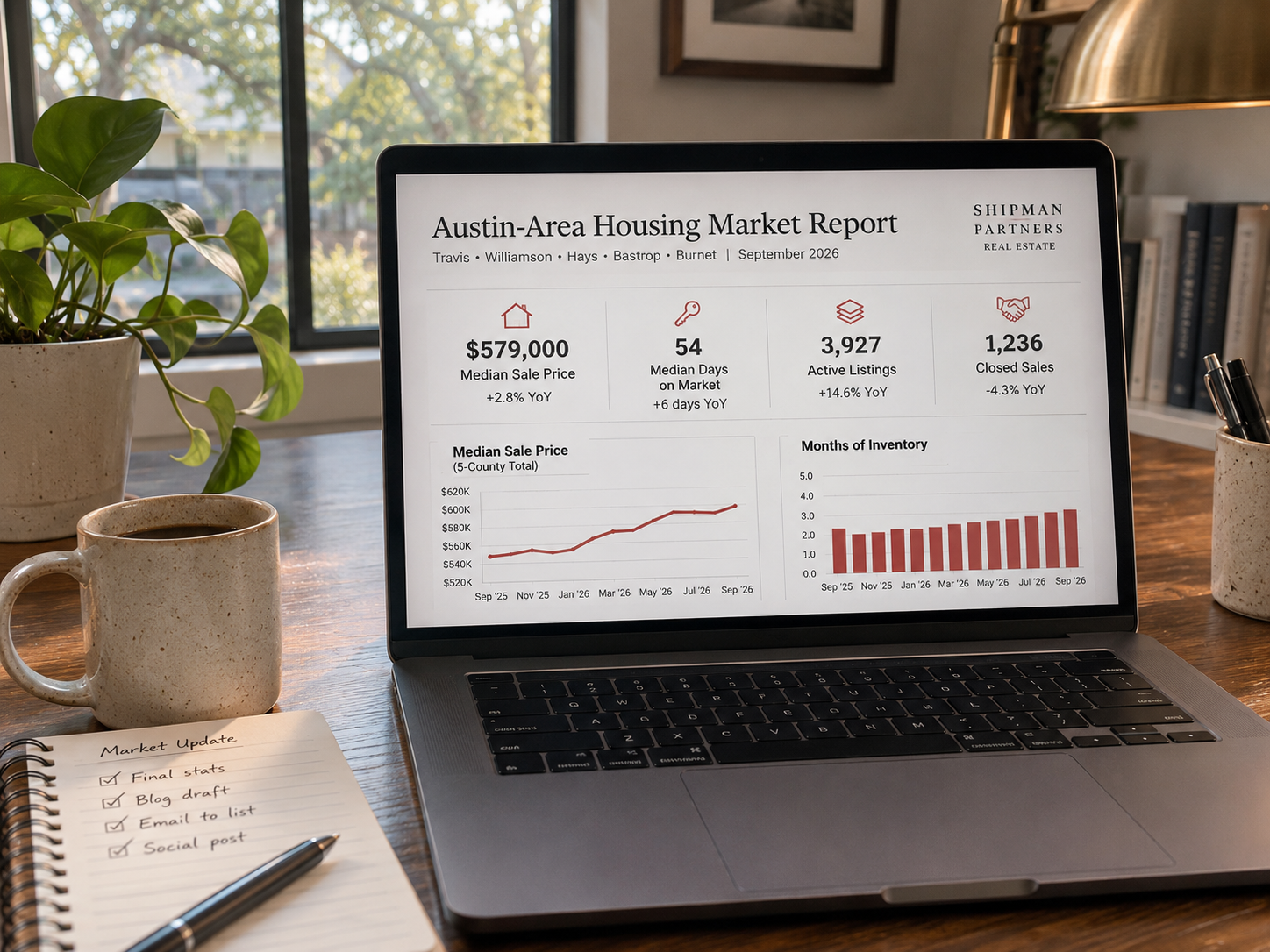
In Freddie Mac's Primary Mortgage Market Survey dated October 29, 2026, the 30-year fixed averaged 7.24%, up from 6.17% a year earlier: a national survey average for well-qualified borrowers, not a quote available to every Austin borrower. Rates roughly a point above the prior winter compress what buyers can carry and narrow the pool able to reach any given price. Section 11 covers what to do about that.
Section 03
Seller Strategy: Pricing and Presentation Carry More Weight
In spring, a mispriced listing often gets rescued by volume. In winter the pool is smaller and refreshes more slowly, so a listing that launches 5% high in December may not get a second serious look until February. Build the pricing analysis from what has gone under contract and closed in your submarket, property type and price tier in the past 90 days, separating the fast sales from the ones that lingered. Active listings tell you what sellers want; pending and closed sales tell you what buyers agreed to. Watch close-to-list in your own comps, not the citywide average. Attention to a new listing is concentrated at the start, so if the first two weeks produce no showing requests the problem is usually price relative to presentation, and waiting rarely fixes it.
Winter Presentation Is Mostly Light and Dryness
- Photography timing. Shoot on a clear day. Overcast winter exteriors compete against listings photographed in spring.
- Interior light and warmth. Shorter days push showings toward dusk, so every bulb should work and the house should not be cold at the door, which raises HVAC questions whether or not any exist.
- Exterior upkeep. Buyers expect dormant grass in January. Dead shrubs and clogged gutters read as deferred maintenance.
- Any evidence of water. A ceiling stain during a January showing costs more in negotiation than the repair would have in November.
- Access. Restricting holiday showings compounds an already smaller pool.
Section 04
November, December, January or February?
The right month depends on your deadline, your carrying costs and your tolerance for market time. Here is how the four behaved in the last completed cycle.
November
753 pending sales, second highest of the four, close-to-list 91.8%. November buyers are frequently on a deadline: a relocation, a lease ending, a reason to close by year end. Fewer casual shoppers, more motivation.
December
The quietest month for new contracts at 594 pending, with the lowest close-to-list at 90.9%. Competing inventory is also thinnest. A December seller trades showings for less competition.
January
Closed sales bottomed at 509, but pending rose to 797, up 9.3% year over year, which Unlock MLS described as signaling strengthening buyer demand. Listing early puts you in place before the February wave.
February
923 pending sales, up 15.1% year over year, and close-to-list recovered to 92.1%. More buyers, and also more sellers, since spring restocking begins here.
All figures City of Austin, from the Unlock MLS monthly reports cited in Section 01. One completed cycle is not a forecast.
Waiting Until Spring Has a Price
Waiting for spring is often right. It is never free. These are the lines to total for each month you wait:
- Principal and interest
- Property taxes, homeowners insurance and HOA dues, in monthly terms
- Utilities, lawn care and routine upkeep
- The cost of the house sitting vacant if you have already moved, including any second housing payment
- The difference between your current loan terms and the terms you expect on your next purchase
Compare three or four months of that total against the price difference you expect a spring launch to produce. It is an arithmetic question with a specific answer for your house, not a seasonal rule.
Section 05
Winter Negotiation: What Is Actually on the Table
The common mistake on both sides is treating negotiation as a single number. In a slower market the other terms are frequently where the deal gets made, because they can be worth more to one party than they cost the other.
A buyer stretched by a 7% rate is usually constrained by monthly payment and cash to close rather than by purchase price. A seller-paid rate buydown or closing-cost credit can improve that buyer's monthly number meaningfully while costing the seller less than an equivalent price cut, and it keeps the sale price in the record for future comparable sales. Whether a particular credit is permitted, and how large it can be, depends on the loan program and lender, so confirm it before it goes into a contract. Other terms worth holding in reserve: a closing date that fits the buyer's lease, a short leaseback, a repair credit, or a home warranty.
What Buyers Can Reasonably Ask For
- Seller-paid closing costs. Reduces cash to close, subject to loan-program limits.
- A rate buydown. Temporary or permanent, paid from seller funds. Availability varies by program.
- Repair credits, or repairs completed before closing. A credit is often easier for a seller to accept; completed repairs are better when the item affects loan approval or insurability.
- A longer option period. In Texas the termination option is negotiated, and holiday contractor availability can make a wider window worth more than a small price concession.
- Closing date, personal property and a home warranty. Small concessions individually, often conceded easily, and worth real money against a lease or an older system.
The Honest Caveat
Nothing on that list is owed to you because it is January. A well-priced house in a sought-after submarket can go under contract quickly in December, and asking for six concessions on it will simply lose it.
Section 06
Buyer Strategy: Where Winter Leverage Actually Comes From
Buyer advantage in winter is real, but situational rather than seasonal; the season simply produces more situations. Fewer active buyers lowers the chance of a multiple-offer situation, which means more room to keep an inspection contingency, a reasonable option period and a financing contingency without being outbid by someone waiving all three. Most discretionary sellers wait for spring, so the ones listed through the holidays usually have a reason: a job move, an estate, a completed build, a house they have already vacated. The most reliable source of winter leverage, though, has nothing to do with weather: a listing that came out in September and is still available in January has absorbed four months of carrying costs.
The Biggest Mistake Winter Buyers Make
Assuming the season entitles them to a discount, and writing offers accordingly. Average close-to-list for the City of Austin never fell below 90.8% in any month of the last completed winter, and that average already includes every stale and heavily reduced listing in the market. A buyer who submits well under asking on everything will lose the good houses and spend the winter negotiating on the ones nobody else wanted. Separate the two questions instead: is this house priced correctly for what it is, and what does this particular seller's situation allow?

Section 07
When a Listing Is Already Sitting
If You Are the Seller
A listing carrying significant market time into winter is harder to move than a new one, because the buyers most likely to want it have already seen it and passed. Separate price from presentation first: views without showings usually point at price or photography, while showings without offers point at something buyers find in the house. Then make a reduction that actually changes the buyer pool, because a small cut that keeps the listing in the same search bracket spends credibility without reaching anyone new. And be clear-eyed about relisting: days on market can reset in MLS systems, but cumulative days on market is reported alongside it and any competent buyer's agent sees both.
If You Are the Buyer Looking at It
A long-sitting listing is both an opportunity and a warning. Ask for the full history: original list price, every reduction with its date, cumulative days on market, and whether it has been under contract before and fallen through. A property that went under contract twice and came back twice usually failed inspection or appraisal.
Then establish why it has not sold. If the reason is price, you have leverage. If the reason is a foundation issue, an unpermitted addition, a drainage problem or a location factor, the discount you negotiate may be paying you for a problem rather than handing you a bargain. Price the problem before you price the house.
Section 08
How Sellers Should Evaluate a Winter Offer
In a slow month, an offer may be the only one you see for several weeks. That should inform how carefully you read it, not how quickly you sign it.
- Net proceeds, not headline price. A higher price with a large credit can net less than a lower price clean.
- Financing strength. A full underwriting pre-approval is a different document from a pre-qualification.
- Appraisal exposure. If the price sits above your recent comparable sales, ask whether the buyer has cash to cover a low appraisal.
- Option period. In Texas the buyer can terminate for any reason during it. Know how long your house is effectively off the market.
- Contingencies on the buyer's own sale. Ask what stage that property is at, not just whether it is listed.
- Timeline fit. A slightly lower offer that closes when you need it can beat a higher one that strands you.
And one judgment call to make with eyes open: in December, the next offer may be six weeks away.
Section 09
Austin Winter Due Diligence: What the Season Lets You See
Central Texas winters are mild on average and occasionally not, and a house inspected in January reveals different things than the same house inspected in July.
What Winter Shows a Buyer
- The heating system under load. A July inspection confirms a furnace turns on; a January inspection shows whether it holds temperature throughout the house.
- Drafts and insulation. Air leaks at windows, doors and attic hatches are easy to feel in January and invisible in September.
- Roof and drainage in rain. Winter rain reveals gutter problems, grading that sends water toward the foundation, and leaking roof penetrations.
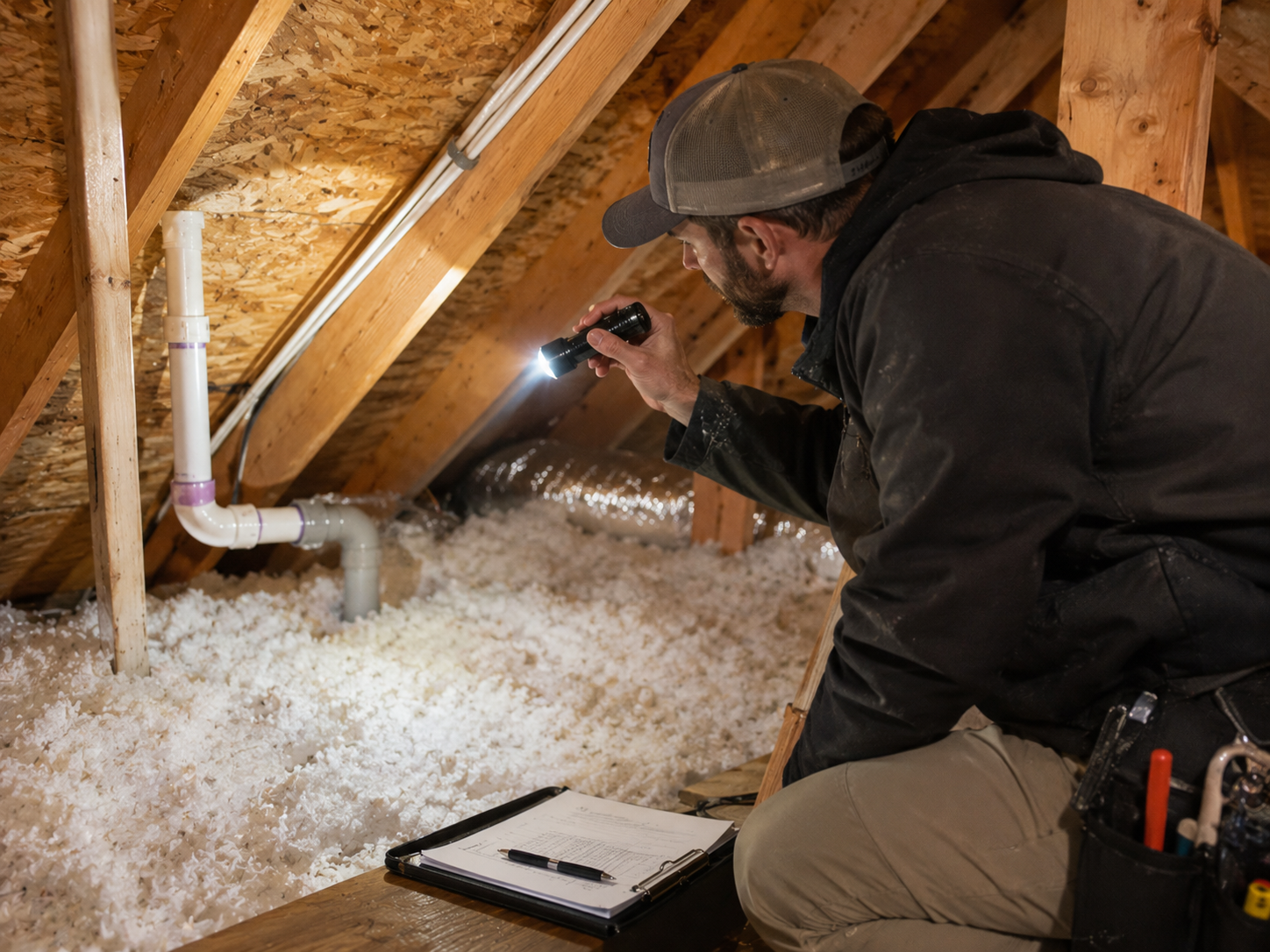
- Plumbing exposure. Ask where the supply lines run. Pipes in uninsulated attics and exterior walls are the ones that fail in a hard freeze.
- Freeze-repair history. Ask whether the property sustained freeze damage in any prior event, what was repaired and whether it was permitted and insured. Request documentation, not a verbal account.
- Tree condition. Bare branches are the easiest time of year to see structural problems in a mature tree near the roof. Hazardous limbs and canopy risk are covered by City of Austin Development Services guidance, not by Austin Water.
Austin Water publishes cold-weather guidance that doubles as an inspection list: insulate pipes in attics and garages, disconnect hoses and cover exterior faucets, drain sprinkler systems, seal drafty windows and doors, and know where the main shutoff valve is. Confirm on the walkthrough that the shutoff is locatable and operable.
For Sellers
The same list is a pre-listing checklist. Insulating exposed pipe, cleaning gutters, correcting grading and having freeze-repair documentation ready are inexpensive compared with what those items cost once a buyer's inspector writes them up.
Pipe, faucet, irrigation, water-heater and freeze-preparation guidance summarized from Austin Water. Hazardous tree limbs and canopy risk are addressed separately by City of Austin Development Services. A general inspection is not a substitute for a licensed professional evaluation of a specific system, and nothing here is a warranty of condition.
Section 10
The January 1 Question: Texas Property Taxes in a Winter Sale
This comes up in nearly every December and January closing, and the common version of it is wrong. Three separate things happen on January 1 under Texas law, and they are often mashed together. It is generally the appraisal valuation date, on which taxable value and most exemption qualifications are determined. A tax lien attaches to the property on that date to secure the year's taxes. And under Texas Tax Code Section 32.07(a), personal liability for the year's tax generally applies to whoever owns or acquires the property on January 1: taxes "are the personal obligation of the person who owns or acquires the property on January 1 of the year for which the tax is imposed," and "a person is not relieved of the obligation because he no longer owns the property."
Tax proration at closing is a separate matter: a contractual allocation between buyer and seller, handled through the settlement statement, which does not change the statutory liability or the lien. None of this means a December 31 closing is better or worse than a January 2 closing. Closing on one side of the date does not by itself create a tax advantage; it changes which party holds the statutory January 1 obligation and what the contract then allocates between them.
Exemptions are where the date has real practical effect. Homestead and other exemptions are generally evaluated as of January 1, and a seller's homestead exemption does not automatically transfer, so a buyer closing in winter should plan on filing their own with the county appraisal district. One timing wrinkle: tax bills are typically mailed in the fall and become delinquent after January 31, so a late-December or January closing can land on either side of that, changing whether the escrow officer prorates an estimated or a billed amount.
Confirm This for Your Transaction
Proration method, exemption status and how the title company handles a tax bill that straddles your closing date are transaction-specific. Confirm them with your title company and, for anything touching your own tax position, a CPA or tax attorney.
Sources: Texas Tax Code Chapter 32, Secs. 32.07(a) and 32.01(a); Texas Comptroller property tax calendar (value determination under Secs. 11.42(a), 23.01(a), 23.12(f); lien attachment under Sec. 32.01(a)). Verified November 2026.
Section 11
Mortgage Rate Timing: What Is Knowable and What Is Not
Buyers ask whether to buy now or wait for rates to fall. Sellers ask whether to wait so more buyers can afford their house. Both require knowing something nobody knows, and institutional forecasts have missed significantly in both directions in recent years.
Two things are worth understanding instead of predicting. Rate relief is not purely good news for buyers: lower rates expand the pool able to afford a given payment, so if rates fall and inventory does not rise to match, competition for the same houses increases. And a rate can be revisited later if rates fall and you qualify; buying the wrong house cannot. Run the payment at today's rate. If it only works at a rate that does not exist yet, that is information about the price, not the timing.
Rate data: Freddie Mac Primary Mortgage Market Survey, week ending October 29, 2026. PMMS reports a national average of rates offered to well-qualified borrowers on conventional conforming loans. It is not a quote, and your rate depends on your credit, down payment, loan program, property type and lender.
Section 12
A Slow Austin Market Is Not Every Austin Submarket
Everything above describes the market in aggregate, and nobody buys or sells the aggregate. The September 2026 report illustrates it: City of Austin median sale price was $570,958, up 4.2% year over year, while the MSA median was $421,000, up 1.4%. Same report, same month, two different stories about price direction.
What Makes One Submarket Behave Unlike Another
- Price tier. Entry-level and high-end segments respond differently to a rate environment, because those buyer pools are financed differently.
- New construction competition. Builder incentives can move faster than resale pricing.
- School attendance zones. Zone-driven demand concentrates buyers on specific streets regardless of season.
- Property type. Detached homes, condominiums and attached products have distinct buyer pools, financing and inventory.
- Commute geography. Proximity to major employment corridors affects demand independently of the seasonal cycle.
The question is never what Austin is doing; it is what has gone under contract within a mile of your house, at your price, in your property type, in the past 90 days, and how long each took. We pull that for clients across Northwest Austin and the surrounding communities.
Section 13
Who Should Actually Buy or Sell This Winter
Winter usually works for a seller who
Has a deadline that does not move: a relocation, a build completion, an estate, or a purchase already under contract. Or is carrying a vacant house, where holding may exceed any spring premium.
Winter deserves a second look for a seller who
Has no deadline and a house needing real repair, where the months until spring are better spent fixing it than marketing it.
Winter usually works for a buyer who
Is ready, with a fully underwritten pre-approval and clear criteria, and values negotiating room and contingency protection over maximum selection.
Winter deserves a second look for a buyer who
Needs a narrow, specific property and would have more to choose from in spring. Or is not yet fully approved, since winter leverage goes to buyers who can perform.
Questions
Questions We Get About the Austin Winter Market
Do Austin home prices drop in the winter?
In the last completed cycle, the City of Austin median sale price moved from $565,000 in November 2025 to $550,000 in December, $522,500 in January and $540,000 in February. Those are medians of what sold each month, and the mix of what sells changes seasonally, so a lower median does not by itself mean an individual house became worth less.
Is December a bad time to list a house in Austin?
December had the fewest new contracts of the four winter months in the last cycle, and also the least competing inventory. It is a reasonable month to list if you have a deadline, price accurately and can hold through January, and a poor month to test a high price.
How much below asking can I offer on an Austin home in winter?
There is no seasonal percentage, and treating one as a rule will cost you houses. Average close-to-list across the City of Austin never fell below 90.8% in any month of the last completed winter, and that already includes every heavily reduced and long-sitting listing. What you can reasonably offer depends on the property: its market time, its reduction history, and how it is priced against recent contracts nearby.
Should I wait until January 1 to close for property tax reasons?
Closing on one side of January 1 does not by itself create a tax advantage. January 1 is generally the appraisal valuation date, the date the tax lien attaches, and the date that fixes statutory personal liability under Texas Tax Code Section 32.07. Proration at closing is a separate contractual allocation. Where the date does have practical effect is exemptions, including homestead, which are generally determined as of January 1 and do not automatically transfer. Confirm proration and exemption handling with your title company and a tax professional.
What should I inspect differently on an Austin home in winter?
Run the heating system long enough to show whether it holds temperature throughout the house, have the inspector note drafts and insulation gaps, watch roof and drainage behavior during a rain event, and ask about pipe runs in attics and exterior walls. Also ask whether the property sustained prior freeze damage, and request documentation.
Is there really less competition from other buyers in the winter?
Generally fewer active buyers, yes. But active inventory was also falling throughout that winter, and as of September 2026 City of Austin active listings were down 10.3% year over year. Fewer buyers chasing fewer listings does not automatically produce less competition on a well-priced house.
Should I just take my house off the market until spring?
It depends on arithmetic you can run. Total your carrying costs for the months until you would relist and compare that against the price difference you expect a spring launch to produce, weighing that spring brings more competing listings as well as more buyers. Section 04 has the line items.
The Bottom Line
Winter Rewards Precision
The Austin market from November through February carries fewer buyers and fewer listings than the spring market, and that cuts both ways. For sellers, pricing and presentation have to be right the first time. For buyers, real negotiating room exists, but it lives in specific properties and specific seller situations, and it frequently arrives as credits, repairs, buydowns and timing rather than as a lower number. The last completed cycle also showed the season is not uniform: contract activity troughed in December and was rebuilding by January, well before anything spring-like.
Thinking about buying or selling this winter?
We will pull recent contract and closing activity for your submarket, price tier and property type, run the carrying-cost math against a spring launch, and tell you honestly which one your numbers favor.
Sources and Methodology
Market data. All Austin market figures come from Unlock MLS Central Texas Housing Reports: the completed November 2025 through February 2026 winter cycle, and the September 2026 report, released October 13, 2026, the most recent month published as of November 4, 2026. Closed sales, pending sales, active listings, median sale price, months of inventory and average close-to-list price are as reported by Unlock MLS and are not recalculated here. Geography is stated with every figure: City of Austin, or the Austin-Round Rock-San Marcos MSA.
Mortgage rates. Freddie Mac Primary Mortgage Market Survey, week ending October 29, 2026: a national average of rates offered to well-qualified borrowers on conventional conforming mortgages, not an available quote.
Property tax. Texas Tax Code Chapter 32 (Secs. 32.01(a) and 32.07(a)) and the Texas Comptroller property tax calendar. Verified November 2026.
Cold weather guidance. Austin Water for pipe, faucet, irrigation, water-heater and freeze-preparation items. City of Austin Development Services for hazardous tree limbs and canopy risk on private property.
What this article does not contain. No figures for November 2026 through February 2027, and no forecast of them. Strategy sections are interpretation and professional judgment rather than data findings. One completed winter cycle is one observation and is not predictive of the next.
This article is general information about the Austin-area real estate market and is not legal, tax, financial or lending advice. Market conditions change continuously and the data cited reflects specific published periods. Loan programs, seller-contribution limits and lender requirements vary and must be confirmed with a licensed loan originator for your situation. Property tax treatment, proration and exemption eligibility should be confirmed with your title company and a qualified tax professional. Nothing here is a warranty or representation regarding the condition of any property. Shipman Partners Real Estate is an equal housing opportunity brokerage.